
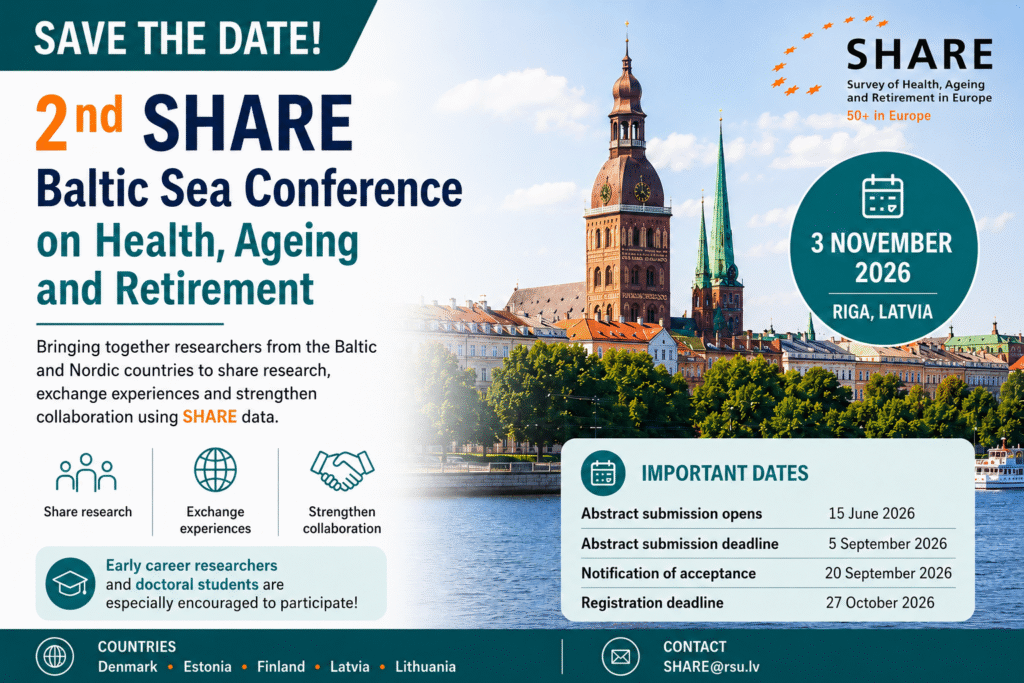
European countries are ageing rapidly, increasing the need for high-quality and internationally comparable data to support research and evidence-based policymaking. The Survey of Health, Ageing and Retirement in Europe (SHARE) is a multidisciplinary and cross-national panel database providing data on the health and socio-economic conditions of people aged 50 and over across Europe.
The second biannual SHARE Baltic Sea Conference will bring together researchers from the Baltic and Nordic countries across different disciplines to share current ageing research, strengthen regional collaboration, and discuss country-specific experiences and research using SHARE data.
Rīga Stradiņš University Anatomy Museum, 9 Kronvalda Boulevard, Rīga
9:30–9:40 | Opening and welcome Aija Bukova-Žideļūna, SHARE Latvia CTL Anda Ķīvīte-Urtāne, Director of Institute of Public Health, Riga Stradins University |
9:40–10:00 | From Scientific Data to Policy Impact, Vytenis Jouzas Deimantas, Data Research Infrastructure Manager, SHARE |
10:00–12:00 | SESSION I: Social Connectedness, Well-Being and Healthy Ageing |
10:00–10:15 | Lonely and Depressed? Not Equally Across Countries Antanas Kairys, Vilnius University, Faculty of Philosophy, Institute of Psychology, Lithuania |
10:15–10:30 | Loneliness and Social Connectedness Among Older Adults: The Role of Age and Gender Tėja Savelytė, Vilnius University, Faculty of Philosophy, Institute of Psychology, Lithuania |
10:30–10:45 | Social Networks in Later Life: Comparing Finland, Sweden, and Denmark with SHARE data Elisa Tambellini, Finland |
10:45–11:00 | Given and Received Neighborly Aid in the Daily Lives of the Ageing Population: European Study Using SHARE Data Antti Kouvo, University of Eastern Finland, Finland |
11:00–11:15 | Intergenerational Solidarity in Europe: Relational Configurations Across Ageing Societies Olga Rajevska, Rīga Stradiņš University, Statistics Unit, Latvia |
11:15–11:30 | Re-partnering Trends in the Baltic States Liili Abuladze, Vytautas Magnus University, Lithuania; Tallinn University, Estonia |
11:30–11:45 | Social Well-Being Factors Associated with Quality of Life Among Older Adults in Latvia Laura Nesaule, Rīga Stradiņš University, Institute of Public Health, Latvia |
11:45–12:00 | Towards a More Comprehensive Measure of Healthy Ageing: Extending the HAI-5 to a Six-Domain Index for European Population Studies Madara Miķelsone, Rīga Stradiņš University, Statistics Unit, Latvia |
12:00–13:00 | Lunch break (lunch at participants’ own expense) |
13:00–15:00 | SESSION II: Work, Care, Health and Later-Life Transitions |
13:00–13:15 | Job Quality and Retirement Intentions in Europe: Universal and Country-Specific Associations Ieva Urbanavičiūtė, Vilnius University, Lithuania |
13:15–13:30 | Changes in Retirement Intentions: Links with Psychological Well-Being and Depressive Symptoms – Longitudinal Evidence from SHARE Raimonda Sadauskaitė, Vilnius University, Institute of Psychology, Lithuania |
13:30–13:45 | Work, Rehabilitation and Retirement Pathways of Older Workers: Findings Based on SHARE and Register Data Inna Lisko, University of Eastern Finland, Finland |
13:45–14:00 | Effectiveness of Rehabilitation: Evidence from Linked Register and Survey Data in Finland Inna Lisko, University of Eastern Finland, FinlandHearing Loss and Cognitive Decline in Older Adults: Psychosocial Mediators and Demographic Moderators Across 18 High-Income Countries |
14:00–14:15 | Heterogeneity of Care Intensity Trajectories Among Informal Caregivers in Europe – Evidence from the Survey of Health, Ageing and Retirement in Europe (SHARE) Data Hanna Viirret, University of Eastern Finland, Finland |
14:15–14:30 | Informal Caregiving and Depressive Symptoms Across 28 Countries: Variation by Gender, Care Relationship, and National Context Xingyue Su, University of Eastern Finland, Finland |
14:30–14:45 | Hearing Loss and Cognitive Decline in Older Adults: Psychosocial Mediators and Demographic Moderators Across 18 High-Income Countries Xu Zong, Faculty of Social Sciences, University of Helsinki, Finland |
14:45–15:00 | The Association of Multidomain Determinants with Moderate-to-Vigorous Physical Activity Among European Adults Aged 50+: A Machine Learning Analysis of the SHARE Cohort Data Rafael Eduardo Ogaz González, University of Groningen, University Medical Center Groningen, Department of Human Movement Sciences, The Netherlands |
15:00–15:45 | Coffee break |
15:45–16:45 | Round Table Discussion: Turning Scientific Data into Evidence for Policy (TBC) |
Organised by the SHARE Latvia with participation of the SHARE country teams from Denmark, Estonia, Finland, and Lithuania.
Researchers from the participating Baltic and Nordic countries are invited to submit abstracts related to health, ageing, retirement, social participation, and welfare research using SHARE data.
Early career researchers and doctoral students are encouraged to participate. The conference provides an excellent opportunity to meet experts from the Baltic and Nordic SHARE country teams, discuss country-specific aspects of SHARE data, exchange experiences, and develop new research collaborations.
Abstracts should be written in English and should not exceed 2,500 characters (including spaces, excluding title and author information). Tables, graphs, and figures should not be included. Abstracts should clearly state the main message and relevance of the study. The abstract should be submitted in .pdf or .docx format.
Please indicate preference for:
The abstract should include:
© 2026 SHARE Estonia. Built using WordPress and the Materialis Theme